So, last week's post discussed the simplest, and yet potentially, most expensive option for temporary housing. This week's dicussion will be the exact oposite. Building a temporary home yourself can be by far the least costly option. It will quite obviously, however, be the most work. Now me, personally, I don't mind breaking a sweat, and putting in the needed hours for this type of project. That mindset is also incredibly important if you are looking to spend as little as possible, working on a very tight budget.
Now, first of all, I want to put one notion to rest right here and now. This is something that I've come face to face with myself along my own journey. And, truthfully, this applies to pretty much anything in life. Do not confuse the idea of costing little to no money with being cheap or sub-standard. Is it true that you get what you pay for? Sure it is! But remember that money isn't the only means of "paying" for something. When you pour every ounce of blood, sweat, and tears into a project - every drop of energy, strength, and faith that it will work - the overwhelming cost can get quite staggering. You are paying quite the price in doing so. And yes, you will get what you pay for in that sense. Don't ever let the monetary value of something fool you into believing you're getting something of higher or lower quality. That is rarely the case. I'll get into resources in a later post. For now, let's focus on the basics of the build, itself.
Now before you decide to build it yourself, you kind of have to decide what it is that you're going to build, right? What are your specific skill sets? What can you learn within whatever time frame you're looking at? What are you legitimately going to be able to do, and feel safe living in, for however long it will take to make your homestead livable? Are you going to put it together and then move it to your site? Or are you planning to build it onsite? These are all things that need to be considered. But I say to dream, and dream big. The bigger the better. Amazing things can happen the bigger you allow yourself to dream, even if it's only meant to be your temporary home. Think outside the box. Or better yet, get rid of the box altogether. Do something unconventional. Let your imagination really go crazy.
Do you want to have a yurt, but don't want or have the money to invest in buying one? Go and do some research, and find out how the Monguls and Turks build theirs. If you are really enterprising (and have the extra time on your hands) felt your own wool for the walls. Even if you don't do it the same way, you can get some great ideas that have already passed the test of time. Or instead of fabric, use a method that is similar in style to building with cob, like here. Or if you want to make sure it remains easily portable, build it onto a small trailer, like here. While these are pre-made, a creative mind could easily build something similar.
If you have some seriously decent skills to go along with the time, try taking that small trailer, and transform it into an actual travel trailer (here), or go retro and make it into a teardrop trailer (here). I even found this one, which I think is absolutely genious. It works great for an individual, but maybe not so much for a family. Basically, it's a small teardrop trailer, built specifically to attach to a bicycle. Or maybe something like this. I really do love this idea! Or for something really "out of the box", check this one out. Ok, so it may not be truly functional. But it is seriously creative!
You could always find an old RV of whatever size that's in need of some rather major help, and transform into whatever you envision. You could even do it with a van, like this young guy did. Now, what I've chosen to do, is to go and get an old school bus to work with. Now you can find them in relatively good condition for a bit more money, like here or here, for example. Or, again, if you don't mind the work, you can get some really cheap from auction sites. See here. More often than not, they won't run, or at least not very well, thus, the lower the price. So some level of mechanical know-how will probably be needed. And, of course, as with any conversion, you can choose whether you want it to have traditional utility hookups, or alternative energy sources.
If portability isn't an issue, and you want to build your temporary home right on your property, then you can always do a small cob, cordwood, or earthbag home, literally, for dirt cheap. You could even use pallets for the frame, and then fill the walls with a cob or rammed earth type mixture. Just remember that with these options, ample time will have to be alotted for the cob to dry completely. Depending on how arid or humid your climate is, that could take days, or even weeks.
When it comes to building things yourself, there really is just about no limit to what you can do. Use any of these ideas, come up with your own, or mix and match however you please. And there are oh, so many other options out there that I can't even begin to cover them all. As with anything else, please do your homework, though. I cannot stress this enough. Even with smaller structures, many communities have various codes and restrictions. They can vary greatly from one area to another. Make sure you know. Beyond that, just have fun!
Monday, June 6, 2016
Tuesday, May 31, 2016
Temporary Housing Part 5: Rentals
This is by far the easiest option in temporary housing. There's really no work, other than normal day to day care. And there are a lot of rental possibilities out there to consider. From a financial standpoint, I don't know that this is an option I would recommend unless you know for sure that your homestead build won't take more than a month or two at most.
There are, of course, the normal options that tend to come to mind. If there are motel rooms close to your property that rent by the week, this could be a good option if you can lock down a good rate. You could even do a home or apartment rental if you are lucky enough to find one with a month to month lease. That way, you're not locked into anything long-term. Now, if your build will take a bit longer, you may even want to look into a rent-to-own deal. There's no pressure to be out by a certain date, you can always sell it again once you're ready to move to your homestead, or you could retain ownership, and rent it out for an added source of income so long as you don't mind being a landlord.
But there are also other options available for rental purposes. If you are considering renting, these may be better if you want to be nearer to, or actually on your property. Not to mention, that if you have children of the 4-legged variety, it can be extremely difficult to find a traditional rental property- some areas, harder than others. But here are a couple of options that are much easier to secure, and they are pet friendly.
RV rentals are good for the very short term. While there are a few companies out there who do rentals, one that is nation-wide and has lots of options is here. They have different sizes available, they allow pets, and they let you choose how long you want your lease to be. Some of their packages do include mileage, as they are designed primarily for vacation purposes, and expect you to be doing a lot of driving. Much like a rental car company, they will let you return it to the place of the rental, or you can arrange a one-way trip. Now this can be a more costly option. Depending on the size of the RV, and how far you want to go, it averages out to roughly $700.00 - $1,000.00 a week. For me, knowing that my homestead will almost certainly take more than a month or two to complete, this option shoots way beyond my price range.
Then there are what are sometimes referred to as "homestead rentals". These are businesses that specifically provide rental accomodations for those who need a place to stay while building their homestead, as well as for any number of other reasons. They offer mobile homes, manufactured homes, travel trailers, converted containers, and cabins. They deliver the home directly to your property, and (generally) offer to hook it up to power, whether it be the grid, or alternative power. Their lease agreements are designed to work with the homesteader, most often at a year or less. Prices vary according to which type of shleter you're looking at and, in some cases, how catered you want it to be to your specific needs. For that reason, an exact price is hard to lock down without going in and filling out a form and/or speaking with someone directly. Now just for a point of fact, I have not done business with any of these companies, so I cannot speak to their reliability or quality. I will tell you, from what research I have done, I haven't found anything - good or bad - with the Better Business Bureau. And there are both good and bad reviews in various discussion forums. I suppose it depends on exactly what you are looking for and how well they fit your needs. As with anything else, I always urge you to please do your homework before making any commitments. See here and here for a couple of these types of rental companies.
Rentals in general may be a good option for you if the budget isn't too horribly tight, your build won't take too long, and if your ideal is to get to your property with a home already in place so that you can get straight to work.on your homestead. Obviously, this would not be the way to go for full-on off-grid living for the prepper who wishes to stay off the radar. But otherwise, it is a very easy option.
There are, of course, the normal options that tend to come to mind. If there are motel rooms close to your property that rent by the week, this could be a good option if you can lock down a good rate. You could even do a home or apartment rental if you are lucky enough to find one with a month to month lease. That way, you're not locked into anything long-term. Now, if your build will take a bit longer, you may even want to look into a rent-to-own deal. There's no pressure to be out by a certain date, you can always sell it again once you're ready to move to your homestead, or you could retain ownership, and rent it out for an added source of income so long as you don't mind being a landlord.
But there are also other options available for rental purposes. If you are considering renting, these may be better if you want to be nearer to, or actually on your property. Not to mention, that if you have children of the 4-legged variety, it can be extremely difficult to find a traditional rental property- some areas, harder than others. But here are a couple of options that are much easier to secure, and they are pet friendly.
RV rentals are good for the very short term. While there are a few companies out there who do rentals, one that is nation-wide and has lots of options is here. They have different sizes available, they allow pets, and they let you choose how long you want your lease to be. Some of their packages do include mileage, as they are designed primarily for vacation purposes, and expect you to be doing a lot of driving. Much like a rental car company, they will let you return it to the place of the rental, or you can arrange a one-way trip. Now this can be a more costly option. Depending on the size of the RV, and how far you want to go, it averages out to roughly $700.00 - $1,000.00 a week. For me, knowing that my homestead will almost certainly take more than a month or two to complete, this option shoots way beyond my price range.
Then there are what are sometimes referred to as "homestead rentals". These are businesses that specifically provide rental accomodations for those who need a place to stay while building their homestead, as well as for any number of other reasons. They offer mobile homes, manufactured homes, travel trailers, converted containers, and cabins. They deliver the home directly to your property, and (generally) offer to hook it up to power, whether it be the grid, or alternative power. Their lease agreements are designed to work with the homesteader, most often at a year or less. Prices vary according to which type of shleter you're looking at and, in some cases, how catered you want it to be to your specific needs. For that reason, an exact price is hard to lock down without going in and filling out a form and/or speaking with someone directly. Now just for a point of fact, I have not done business with any of these companies, so I cannot speak to their reliability or quality. I will tell you, from what research I have done, I haven't found anything - good or bad - with the Better Business Bureau. And there are both good and bad reviews in various discussion forums. I suppose it depends on exactly what you are looking for and how well they fit your needs. As with anything else, I always urge you to please do your homework before making any commitments. See here and here for a couple of these types of rental companies.
Rentals in general may be a good option for you if the budget isn't too horribly tight, your build won't take too long, and if your ideal is to get to your property with a home already in place so that you can get straight to work.on your homestead. Obviously, this would not be the way to go for full-on off-grid living for the prepper who wishes to stay off the radar. But otherwise, it is a very easy option.
Monday, May 23, 2016
Temporary Housing Part 4: Shipping Containers
Ah, yes. This one was inevitable. Even for those who are new at the idea of looking for alternative or off-grid or, possibly, temporary housing, odds are that you have heard about shipping containers. They seem to be the most commonly talked about option. Why? I'm not entirely sure, to tell you the truth. Compared to the other options I've already discussed, they generally do tend to cost less. They are also seemingly abundant. However, they also take a great deal of work to make them livable.
On average, the going price for a 20 foot container is in the neighborhood of $2,000, but can vary widely. Before I started really looking into this as an option, I had no idea whatsoever that shipping containers are not all created equal. I mean, think about it. When you see them riding on trains, and holding you up in traffic, they all look pretty much the same. When you see cargo ships all loaded up, they all seem perfectly identical, except for the paint job. However, they actually come in several different sizes, the most common being 10', 20', 30', 40', and 50' in length. They're generally 8' wide and roughly 8'6" tall, although there are variances. They are also made from a variety of materials, depending on the original purpose. But the type that is best for making a suitable living environment is "Cor-Ten Steel". They are designed specifically to withstand inclement weather while sitting on a cargo ship. They are going to last longer than other types of continers. It's sturdy enough to live in, but also easy to fix up and customize, relatively speaking.
Where do you go to buy a shipping container? If you are fortunate enough to live close to a shipyard, then you can go down there and ask. More often than not, there are a good deal of containers that cannot or will not be used for actual shipping. This can happen for any number of reasons. Just be sure you know what you're getting, and that you can clean it as it needs. You don't really want to try to live in something that was used to transport toxic waste or anything, right? But there are generally so many containers on hand at any given moment, that the owners at shipyards can become quite desparate to get rid of them. If you're good at negotiating, you could pull in a pretty sweet deal, especially if you want more than one. Another place to look is warehouse districts. Again, they can get anxious to get rid of them if you ask at the right time. There are a great many places online that specialize in selling shipping containers. Now there, you will get a new(er) container, and have more options in sizing. But you're also going to pay a higher price, plus the shipping cost of getting the container to you. But there are also options that you might not think of immediately. Check out Craigslist or Ebay. They do pop up often. In fact, there are currently several listed on Ebay. I saw a 20' go for less than $500 over there not too long ago. Just remember to look at the fine print so you know whether or not they'll ship to you, or if it's pick up only.
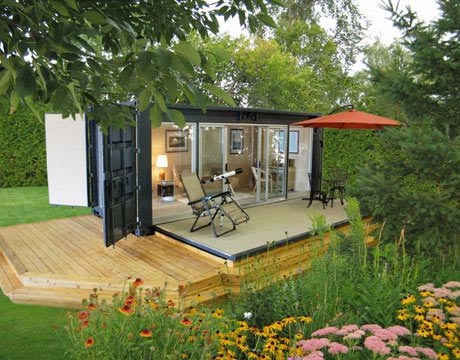
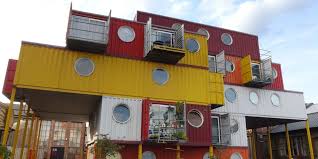
Now, what can you do with a shipping container? Honestly, the possibilities are endless. Dig a bit and put it underground, or build a deck around it for a swimming pool. Leave it simple, and, if it's temporary, use it as a garage, workshop, extra storage, or whatever, after you move out. Or make it as elaborate as you want, either as a single container, or with several put together. Cut out sides, alter the roof line, whatever you can think of. I'm not going to get into a lot of detail on this, just because the internet is already so saturated with loads of information out there on using shipping containers as homes. So I'll just leave you this time with a LOT of pictures. Let your imagination go wild!
On average, the going price for a 20 foot container is in the neighborhood of $2,000, but can vary widely. Before I started really looking into this as an option, I had no idea whatsoever that shipping containers are not all created equal. I mean, think about it. When you see them riding on trains, and holding you up in traffic, they all look pretty much the same. When you see cargo ships all loaded up, they all seem perfectly identical, except for the paint job. However, they actually come in several different sizes, the most common being 10', 20', 30', 40', and 50' in length. They're generally 8' wide and roughly 8'6" tall, although there are variances. They are also made from a variety of materials, depending on the original purpose. But the type that is best for making a suitable living environment is "Cor-Ten Steel". They are designed specifically to withstand inclement weather while sitting on a cargo ship. They are going to last longer than other types of continers. It's sturdy enough to live in, but also easy to fix up and customize, relatively speaking.
Where do you go to buy a shipping container? If you are fortunate enough to live close to a shipyard, then you can go down there and ask. More often than not, there are a good deal of containers that cannot or will not be used for actual shipping. This can happen for any number of reasons. Just be sure you know what you're getting, and that you can clean it as it needs. You don't really want to try to live in something that was used to transport toxic waste or anything, right? But there are generally so many containers on hand at any given moment, that the owners at shipyards can become quite desparate to get rid of them. If you're good at negotiating, you could pull in a pretty sweet deal, especially if you want more than one. Another place to look is warehouse districts. Again, they can get anxious to get rid of them if you ask at the right time. There are a great many places online that specialize in selling shipping containers. Now there, you will get a new(er) container, and have more options in sizing. But you're also going to pay a higher price, plus the shipping cost of getting the container to you. But there are also options that you might not think of immediately. Check out Craigslist or Ebay. They do pop up often. In fact, there are currently several listed on Ebay. I saw a 20' go for less than $500 over there not too long ago. Just remember to look at the fine print so you know whether or not they'll ship to you, or if it's pick up only.
Now, what can you do with a shipping container? Honestly, the possibilities are endless. Dig a bit and put it underground, or build a deck around it for a swimming pool. Leave it simple, and, if it's temporary, use it as a garage, workshop, extra storage, or whatever, after you move out. Or make it as elaborate as you want, either as a single container, or with several put together. Cut out sides, alter the roof line, whatever you can think of. I'm not going to get into a lot of detail on this, just because the internet is already so saturated with loads of information out there on using shipping containers as homes. So I'll just leave you this time with a LOT of pictures. Let your imagination go wild!
Monday, May 16, 2016
Temporary Housing Part 3: Pre-Fab
Ok, bear with me on this one. When I say pre-fab, I'm not talking about the run-of-the-mill fabricated housing that you can find in anytown, USA. Those do serve a purpose, and actually can be used for the purposes discussed here, if so desired. But I want to talk about something a little bit different.
So what am I talking about? A simple search online for prefab structures will yield numerous results. Because of the sheer amount of companies that create pre-fab housing and other structures, the price range is huge. The prices generally range anywhere from roughly $1,000 to upwards of $90,000, depending on what you want. Some will list a price in square footage. That may give greater customization, but it can add up surprisingly fast. You could even take an otherwise inocuous pre-made structure like a shed and turn it into a tiny house with a bit of work. Or you can go as simple as to buy building plans for somewhere in the neighborhood of $150.00. But aside from the typical pre-fab housing that we are all used to, I'd like to point out a few options that aren't typical. If you like the idea of different and unique, then these products just might be for you.
First, is a company called Intershelter. It's really a neat idea of a series of prefabricated panels, made from an "aerospace composite material". These panels are designed to be put together and taken apart quickly, generally, in just a few hours. They are circular and concave in shape, thus creating a dome. The website claims that once built, they can withstand earthquakes, category 5 hurricanes, and tempuratures ranging from -70F to +120F, making it ideal for any climate. There are pricing differences depending on the climate you are buying for. They offer 14 foot or 20 foot diameter. For a 14 foot, the basic dome runs $9,500, and a "polar dome" runs $11,500. A kit for a single dome can fit easily into the bed of a pickup to make for easy portablility, and two or more can be attached together for a bigger space.
Then there is Green Magic Homes. I personally, really like the look of these. Again, they are prefabricated panels. Only this time, they are designed specifically to be placed with earth on top of them, making them, more or less, an underground home. The shape of the panels is somewhat difficult to describe. Once the panels are fit together, and they are covered, the pressure of the soil above and around actually pushes the panels in towards each other, making them stronger. They arrive, ready to put up using only glue and screws. On average, it will most likely take a couple of days for completion of the build. The site, itself, lists no prices, asking for you to request the information from them. However, through numerous "outside" sources, the prices seem to range from $35.00 - $42.00 per square foot, with the sizes being 700 to 1,900 square feet. And, just like the dome, multiple units can be put together to form bigger living spaces. It just comes down to how much you want to spend.
Now, both of the previous products are the shells only. There is nothing else included: no bathrooms, kitchens, etc. This is also the same as both the yurts and inflatable concrete I discussed in my last two posts. All of that is work that you will have to take upon yourself. My final option for pre-fab housing, however, is somewhat different. Now, to my knowledge, none of these have officially hit the market, yet. But they are well on their way. Here, I am talking about homes built for the annual Solar Decathalon put on by the US Department of Energy. Teams of college students from around the country are asked to design solar powered homes that are affordable, functional, and eco-friendly. Designed to be premanent dwellings, I'm including them here because they tend to be pre-fab designs of some sort, which helps with the affordability. Most claim to run in the neighborhood of $20,000. While that may be a bit more than you'd like to pay if this is going to be temporary, if it's a permanent home, that would be a great deal. But, if nothing else, it can give you some great ideas to let your creativity go and have some fun with design.
If the idea of pre-fab calls to you, there are many many many other sites and companies out there that offer a wide variety of products at an equally varied range in pricing. In fact, here is one I came across shortly before this posting. I haven't had the chance to thoroughly research it yet, but it looks promising. And there are constantly new options coming onto the market in this area. It always comes down to the simple question of how much you are willing to spend.
So what am I talking about? A simple search online for prefab structures will yield numerous results. Because of the sheer amount of companies that create pre-fab housing and other structures, the price range is huge. The prices generally range anywhere from roughly $1,000 to upwards of $90,000, depending on what you want. Some will list a price in square footage. That may give greater customization, but it can add up surprisingly fast. You could even take an otherwise inocuous pre-made structure like a shed and turn it into a tiny house with a bit of work. Or you can go as simple as to buy building plans for somewhere in the neighborhood of $150.00. But aside from the typical pre-fab housing that we are all used to, I'd like to point out a few options that aren't typical. If you like the idea of different and unique, then these products just might be for you.
First, is a company called Intershelter. It's really a neat idea of a series of prefabricated panels, made from an "aerospace composite material". These panels are designed to be put together and taken apart quickly, generally, in just a few hours. They are circular and concave in shape, thus creating a dome. The website claims that once built, they can withstand earthquakes, category 5 hurricanes, and tempuratures ranging from -70F to +120F, making it ideal for any climate. There are pricing differences depending on the climate you are buying for. They offer 14 foot or 20 foot diameter. For a 14 foot, the basic dome runs $9,500, and a "polar dome" runs $11,500. A kit for a single dome can fit easily into the bed of a pickup to make for easy portablility, and two or more can be attached together for a bigger space.
Then there is Green Magic Homes. I personally, really like the look of these. Again, they are prefabricated panels. Only this time, they are designed specifically to be placed with earth on top of them, making them, more or less, an underground home. The shape of the panels is somewhat difficult to describe. Once the panels are fit together, and they are covered, the pressure of the soil above and around actually pushes the panels in towards each other, making them stronger. They arrive, ready to put up using only glue and screws. On average, it will most likely take a couple of days for completion of the build. The site, itself, lists no prices, asking for you to request the information from them. However, through numerous "outside" sources, the prices seem to range from $35.00 - $42.00 per square foot, with the sizes being 700 to 1,900 square feet. And, just like the dome, multiple units can be put together to form bigger living spaces. It just comes down to how much you want to spend.
Now, both of the previous products are the shells only. There is nothing else included: no bathrooms, kitchens, etc. This is also the same as both the yurts and inflatable concrete I discussed in my last two posts. All of that is work that you will have to take upon yourself. My final option for pre-fab housing, however, is somewhat different. Now, to my knowledge, none of these have officially hit the market, yet. But they are well on their way. Here, I am talking about homes built for the annual Solar Decathalon put on by the US Department of Energy. Teams of college students from around the country are asked to design solar powered homes that are affordable, functional, and eco-friendly. Designed to be premanent dwellings, I'm including them here because they tend to be pre-fab designs of some sort, which helps with the affordability. Most claim to run in the neighborhood of $20,000. While that may be a bit more than you'd like to pay if this is going to be temporary, if it's a permanent home, that would be a great deal. But, if nothing else, it can give you some great ideas to let your creativity go and have some fun with design.
If the idea of pre-fab calls to you, there are many many many other sites and companies out there that offer a wide variety of products at an equally varied range in pricing. In fact, here is one I came across shortly before this posting. I haven't had the chance to thoroughly research it yet, but it looks promising. And there are constantly new options coming onto the market in this area. It always comes down to the simple question of how much you are willing to spend.
Monday, May 9, 2016
Temproary Housing Part 2: Inflatable Concrete
Inflatabe concrete. Sounds a little crazy and out there, doesn't it? But it does exsist. And, in all truth, not a bad idea. Aesthetically pleasing? Well, maybe not so much. Let's a lot of light in? Nope, not really. Costly? Not horrible. Doable by only one or two people? Yes. Durable? Well, I think that one goes without saying. It is concrete we're talking about, after all.
Ok, so let's talk about this. This is a relatively new idea, and one that does have it's merits. Sometimes referred to as concrete tents or simply concrete canvas, these were originally marketed as fallout shelters and for various military applications. As of right now, there are two primary companies making these types of shelters. The first one, is primarily utilitarian. No windows, a door on each end, pretty much like a bunker. The other is a little better well designed, having living space as the primary purpose. It looks more like a house, has more windows, but pretty much goes up just as easily. Now, if this is going to be a temporary residence for you, this would be a fairly descent option if you are building in tornado alley, as you could easily use it for shelter. Especially, if you have the foresight and desire to place it at least partially underground. Or, you could even bury it almost completely and create your own version of a Hobbit house.
The basic idea is that you have a large package of this flexible material. Soak this material until fully wet to the touch. At that point, all you need is a good source of air, and a vehicle with a tow cable, or some other source, with which you can unfold the material as it fills with air. The material itself is a durable fabric that is impregnated with concrete fiber. Once it is set up and filled with air, it will generally dry within 24-48 hours. When completely dry, it is said to be both fire and water proof. It can be, however, thin enough that, with proper tools, can have window openings cut into it. Check here to see a video of a concrete shelter being put up.
Both versions can have two or more shelters join together for more space. In that way, it is extremely customizable. While one manufacturer (here) lists a price of $3,500 per unit, the other manufacturer (here) lists their prices from $23 - $60 per square meter. They are an international comany, and prices range by region. They also offer a bit of range in the thickness of the material, as well as offering sheets of the material for other purposes. They have a link on their site to find and contact a local dealer to obtain more specific pricing information. There may be other companies out there that also offer a similar product. As of this writing, however, every site I have found, links back to one of these two companies.
What you get is essentially a blank canvas where your imagination can go wild with uses. And whereas the appearance may or may not be ideal, it is a genuine option worth considering, whether it be for a temporary residence or something more permanent. This is an option I would actually consider just due to it's ease and speed in putting it up. And it could have use down the road as something along the lines of a root cellar, if nothing else.
Ok, so let's talk about this. This is a relatively new idea, and one that does have it's merits. Sometimes referred to as concrete tents or simply concrete canvas, these were originally marketed as fallout shelters and for various military applications. As of right now, there are two primary companies making these types of shelters. The first one, is primarily utilitarian. No windows, a door on each end, pretty much like a bunker. The other is a little better well designed, having living space as the primary purpose. It looks more like a house, has more windows, but pretty much goes up just as easily. Now, if this is going to be a temporary residence for you, this would be a fairly descent option if you are building in tornado alley, as you could easily use it for shelter. Especially, if you have the foresight and desire to place it at least partially underground. Or, you could even bury it almost completely and create your own version of a Hobbit house.
The basic idea is that you have a large package of this flexible material. Soak this material until fully wet to the touch. At that point, all you need is a good source of air, and a vehicle with a tow cable, or some other source, with which you can unfold the material as it fills with air. The material itself is a durable fabric that is impregnated with concrete fiber. Once it is set up and filled with air, it will generally dry within 24-48 hours. When completely dry, it is said to be both fire and water proof. It can be, however, thin enough that, with proper tools, can have window openings cut into it. Check here to see a video of a concrete shelter being put up.
Both versions can have two or more shelters join together for more space. In that way, it is extremely customizable. While one manufacturer (here) lists a price of $3,500 per unit, the other manufacturer (here) lists their prices from $23 - $60 per square meter. They are an international comany, and prices range by region. They also offer a bit of range in the thickness of the material, as well as offering sheets of the material for other purposes. They have a link on their site to find and contact a local dealer to obtain more specific pricing information. There may be other companies out there that also offer a similar product. As of this writing, however, every site I have found, links back to one of these two companies.
What you get is essentially a blank canvas where your imagination can go wild with uses. And whereas the appearance may or may not be ideal, it is a genuine option worth considering, whether it be for a temporary residence or something more permanent. This is an option I would actually consider just due to it's ease and speed in putting it up. And it could have use down the road as something along the lines of a root cellar, if nothing else.
Monday, May 2, 2016
Temporary Housing Part 1: Yurts
In my last post, I talked about the process of building a homestead when you have little to no idea where to start. Well, this is where I started - temporary housing. When looking to build a homestead, you will more than likely find yourself in need of temporary housing, especially if you are moving some distance away. There are many different options out there, some of which, I didn't know about before I began my research.. Each one has their own pro's and con's. It just all depends on your personal wants and needs. And some of these that I'm writing about as "temporary" could very easily be used as a permanent home. I'm also fairly certain that there are still other options out there that I have yet to come across. In order to keep individual posts relatively short, I am going to break this down and discuss only one, possibly two, of these options per post. To try to cover them all would make for a very long read. So, let's get started.
The first type of temporary housing that I'll talk about is a yurt. If you're not familiar with these little gems, you might want to familiarize yourself. Yurts have been used for roughly 3000 years by various nomadic groups of people, covering central and eastern Asia. There is even said to be archaeological evidence that Ghengis Khan and his men lived in yurts. Traditionally, a yurt has an easily put-together frame of wooden rods that is then covered in layers of wool that had been worked into felt. They are round with a slightly pitched roof, raising to a high point in the center. Doorways range from wooden doors (Mongolian yurts) to felt or rugs hanging over the doorway (Turkish yurts). These are the homes, still in use even today, by people that migrate and move around regularly, mainly those that raise animals that need to move for grazing and such. Because they move so much, the yurt must be able to go up and come down again quickly and repeatedly, and obviously, easy to move. Remember, these nomads can cover huge areas, sometimes consisting of hundreds of square miles.
Now, the average person or family in a more modern society is probably not going to be following herds of animals across hundreds of miles, nor will the average person be in need of a dwelling that will go up and down multiple times every season. But the concept of a yurt is a really good one. A lattice frame is put up on top of a flat base. Then roof beams are secured onto the walls, and a covering of "architectural grade fabric" is then attached to the exterior of the walls. A standard yurt will have one or two windows, which may or may not open, and a single door. There are a decent variety of sizes, ranging from 6' to 30' in diameter. And the additions and customizations are numerous. You choose the color of the exterior, and then, for more money, you can add more windows of different sizes, more doors, a skylight over the center of the roof, a front porch, a "hallway" to connect two or more yurts together, double tall walls, or a special "cut away" to enable securing the chimney for a wood burning stove. And then there are special packages that different companies offer for varying snow and wind loads. Different companies offer different things with each individual package, and some won't give you a price until you fill out a custom form. Now that doesn't make you contractually obligated to purchase what you're putting in there. Just prepare yourself. If you're not expecting it, it can take some time. But it can also be quite fun playing around with different options and ideas.
Yurts can be quite costly. Of the different companies I've looked at so far, the sizes are comparable. See here, here, and here for starters. And there are many more. When comparing these companies, the prices are generally within a few hundred dollars of each other. The smaller yurts generally start around $5,000 and go up to $10,000 or more for the larger ones. Those are the base prices for a standard yurt. There might be a delivery fee (separate from shipping), or a set-up fee if they have the option of putting the yurt up for you. Personally, I would not take that option. Yurts, even these modern ones, are designed to go up quickly and easily. Most companies provide detailed instructions for building the yurt, and most buyers can put a yurt up themselves in under a day, sometimes in as little as just a couple of hours for the smaller sized yurts. Apparently, the most time consuming part of the process is building the platform on which the yurt will sit. And just know that none of the companies I've looked at offer the platform. You are expected to do that part yourself.
Also remember that the price you are paying is for the yurt and the yurt only. In all of the pictures on these various sites, you are going to see beautiful interiors, sometimes even marble kitchen counters, walls, and sometimes lofts. All of these things may help to sell more yurts, but those are things that you provide. I have not seen a yurt company yet that offers any of the interior elements. Please keep that in mind if you are looking to purchase a yurt. This may or may not be an issue of concern, depending on how much work you can or are willing to do yourself.
So basically, yurts are a great option for speed and convenience, but can be costly to purchase, and even more costly on interior design unless you do the work yourself. They can be a good investment if you are looking for a more permanent residence, or are planning on using it perhaps as a guest house. They could probably even be taken camping depending on the base underneath. I came across one that someone had built onto a small trailer, like the kind used for lawn services. They can sometimes be found used, like here. More often than not, they are still in relatively good condition. And like just about anything else, the better condition it's in, the more you are likely to pay. At that point, you might do just as well to purchase new.
Finally, there is always the option of building one yourself, completely from scratch. This option is way less expensive, but also way more time consuming. It does make the ability of customization much easier, and more flexible. However, this is something that you're more than likely going to want to keep other uses in mind for down the road if this is going to be temporary for you. For the work that goes into it, make sure to invest some planning, as well. Choose a place you'll be happy with on your property, and it can have continued use as a shed, garage, guest house, or anything else you might choose later on. I'll get into this option a little more in a later post.
So there is one option for consideration in temporary housing as you look to build your homestead. And this is one that can also be used permanently, if so desired. There are many many more options to come, so stay tuned.
The first type of temporary housing that I'll talk about is a yurt. If you're not familiar with these little gems, you might want to familiarize yourself. Yurts have been used for roughly 3000 years by various nomadic groups of people, covering central and eastern Asia. There is even said to be archaeological evidence that Ghengis Khan and his men lived in yurts. Traditionally, a yurt has an easily put-together frame of wooden rods that is then covered in layers of wool that had been worked into felt. They are round with a slightly pitched roof, raising to a high point in the center. Doorways range from wooden doors (Mongolian yurts) to felt or rugs hanging over the doorway (Turkish yurts). These are the homes, still in use even today, by people that migrate and move around regularly, mainly those that raise animals that need to move for grazing and such. Because they move so much, the yurt must be able to go up and come down again quickly and repeatedly, and obviously, easy to move. Remember, these nomads can cover huge areas, sometimes consisting of hundreds of square miles.
Now, the average person or family in a more modern society is probably not going to be following herds of animals across hundreds of miles, nor will the average person be in need of a dwelling that will go up and down multiple times every season. But the concept of a yurt is a really good one. A lattice frame is put up on top of a flat base. Then roof beams are secured onto the walls, and a covering of "architectural grade fabric" is then attached to the exterior of the walls. A standard yurt will have one or two windows, which may or may not open, and a single door. There are a decent variety of sizes, ranging from 6' to 30' in diameter. And the additions and customizations are numerous. You choose the color of the exterior, and then, for more money, you can add more windows of different sizes, more doors, a skylight over the center of the roof, a front porch, a "hallway" to connect two or more yurts together, double tall walls, or a special "cut away" to enable securing the chimney for a wood burning stove. And then there are special packages that different companies offer for varying snow and wind loads. Different companies offer different things with each individual package, and some won't give you a price until you fill out a custom form. Now that doesn't make you contractually obligated to purchase what you're putting in there. Just prepare yourself. If you're not expecting it, it can take some time. But it can also be quite fun playing around with different options and ideas.
Yurts can be quite costly. Of the different companies I've looked at so far, the sizes are comparable. See here, here, and here for starters. And there are many more. When comparing these companies, the prices are generally within a few hundred dollars of each other. The smaller yurts generally start around $5,000 and go up to $10,000 or more for the larger ones. Those are the base prices for a standard yurt. There might be a delivery fee (separate from shipping), or a set-up fee if they have the option of putting the yurt up for you. Personally, I would not take that option. Yurts, even these modern ones, are designed to go up quickly and easily. Most companies provide detailed instructions for building the yurt, and most buyers can put a yurt up themselves in under a day, sometimes in as little as just a couple of hours for the smaller sized yurts. Apparently, the most time consuming part of the process is building the platform on which the yurt will sit. And just know that none of the companies I've looked at offer the platform. You are expected to do that part yourself.
Also remember that the price you are paying is for the yurt and the yurt only. In all of the pictures on these various sites, you are going to see beautiful interiors, sometimes even marble kitchen counters, walls, and sometimes lofts. All of these things may help to sell more yurts, but those are things that you provide. I have not seen a yurt company yet that offers any of the interior elements. Please keep that in mind if you are looking to purchase a yurt. This may or may not be an issue of concern, depending on how much work you can or are willing to do yourself.
So basically, yurts are a great option for speed and convenience, but can be costly to purchase, and even more costly on interior design unless you do the work yourself. They can be a good investment if you are looking for a more permanent residence, or are planning on using it perhaps as a guest house. They could probably even be taken camping depending on the base underneath. I came across one that someone had built onto a small trailer, like the kind used for lawn services. They can sometimes be found used, like here. More often than not, they are still in relatively good condition. And like just about anything else, the better condition it's in, the more you are likely to pay. At that point, you might do just as well to purchase new.
Finally, there is always the option of building one yourself, completely from scratch. This option is way less expensive, but also way more time consuming. It does make the ability of customization much easier, and more flexible. However, this is something that you're more than likely going to want to keep other uses in mind for down the road if this is going to be temporary for you. For the work that goes into it, make sure to invest some planning, as well. Choose a place you'll be happy with on your property, and it can have continued use as a shed, garage, guest house, or anything else you might choose later on. I'll get into this option a little more in a later post.
So there is one option for consideration in temporary housing as you look to build your homestead. And this is one that can also be used permanently, if so desired. There are many many more options to come, so stay tuned.
Tuesday, April 26, 2016
It Starts with a Dream
For as long as I can remember, I've had a dream. I was born in Colorado, and lived close to the mountains for the first few years of my life. I've dreamt of returning to them since I left. As I got older, I developed a strong love of nature, and how to live in harmony with her. This wasn't always easy, as I lived a typical life in a typical house doing typical things. Both of my parents had a garden. My mom had her flowers and my dad had the veggies and some fruit. I helped a little, but didn't really learn enough to be successful in my own gardening for quite some time. Well, the years passed, and, as they say, life got in the way. I had other interests and passions, I went to college, got married, got divorced, got married again, had a child, got divorced again. Somewhere in there, my dreams got pushed off to the side.
After my second divorce, it took some time to pull my life back from the pieces, and eventually, those dreams came flooding back to the surface. And this time, they came back with an all-new vision, partially inspired by my son. My dream now encompases so much more than what it started with. Moving back to the mountains, absolutely! I dream of an off-grid homestead, raising animals and growing food. While I've always had a heart for the homeless, my son expanded my original dream by including them in the picture. We want to develop an off-grid community for the homeless. My son has a heart of gold.
So this is a doable dream, right? Yes, it is. But there is a hitch. Growing up the way I did, I know the basics of cooking from scratch, making clothes, and things such as that. I can sew, knit, and crochet. I know basic woodworking, thanks to my grandfather. But when it comes to building, especially in alternative methods, I am absolutely clueless. Then there is the alternative energy sources. Not to mention I have no experience whatsoever in raising livestock. And I already mentioned my lack of success in gardening. So I find myself feeling as though I'm going back to school. So much to learn, and in so many different arenas.
Plus, there is actually getting to Colorado. Just load up a moving truck and go, you say? Not so fast. I have several four-legged children, making a moving van from Florida to Colorado out of the question. They need to be comfortable and feel safe during the move. So I thought of getting an RV. Considering it's going to be just myself and my son, it must be safe and reliable. And I just don't feel comfortable purchasing a used one. New ones are way out of my price range. I could rent one. But then where to live once we get to Colorado? So, I have decided to buy a school bus. Used, yes. But I can pretty much guarantee you that the structure of a used bus will be in much better condition than that of a used RV. The mechanics will undoubtedly need a lot of work. But that would be true of anything used.
This is the beginning of a long journey. To make matters more difficult, my financial situation is, well.... let's just say it's very fragile due to a lot of extenuating circumstances. So here is the plan. I am going to attempt to convert a bus to a livable RV, move myself, my son, and our furr babies from Florida to Colorado, acquire a piece of land, and build an off-grid homestead that, by the way, will be wanting for nothing in the way of comforts. Now I have never understood why it should take a large investment to get to a simpler way of living. That idea just seems so counter-intuitive to me. So with that in mind, I am going to attempt to do this with as little money as possible. The first step is the research. Lots and lots of research. I am going to document every step along the way. This will not only help me, but I am doing it this way because maybe there are other people out there like me. People who long for a simpler life, have little to no money, and have no idea how or where to start. Along the way, I'll share what I've learned. Being as I'm learning in this process, I welcome any and all helpful and encouraging insights. But please, nothing degrading or insulting, to myself or anyone else. What is common sense to the spider is not necessarily common sense to the fly. This is a learning and sharing experience. Please join me on my journey.
After my second divorce, it took some time to pull my life back from the pieces, and eventually, those dreams came flooding back to the surface. And this time, they came back with an all-new vision, partially inspired by my son. My dream now encompases so much more than what it started with. Moving back to the mountains, absolutely! I dream of an off-grid homestead, raising animals and growing food. While I've always had a heart for the homeless, my son expanded my original dream by including them in the picture. We want to develop an off-grid community for the homeless. My son has a heart of gold.
So this is a doable dream, right? Yes, it is. But there is a hitch. Growing up the way I did, I know the basics of cooking from scratch, making clothes, and things such as that. I can sew, knit, and crochet. I know basic woodworking, thanks to my grandfather. But when it comes to building, especially in alternative methods, I am absolutely clueless. Then there is the alternative energy sources. Not to mention I have no experience whatsoever in raising livestock. And I already mentioned my lack of success in gardening. So I find myself feeling as though I'm going back to school. So much to learn, and in so many different arenas.
Plus, there is actually getting to Colorado. Just load up a moving truck and go, you say? Not so fast. I have several four-legged children, making a moving van from Florida to Colorado out of the question. They need to be comfortable and feel safe during the move. So I thought of getting an RV. Considering it's going to be just myself and my son, it must be safe and reliable. And I just don't feel comfortable purchasing a used one. New ones are way out of my price range. I could rent one. But then where to live once we get to Colorado? So, I have decided to buy a school bus. Used, yes. But I can pretty much guarantee you that the structure of a used bus will be in much better condition than that of a used RV. The mechanics will undoubtedly need a lot of work. But that would be true of anything used.
This is the beginning of a long journey. To make matters more difficult, my financial situation is, well.... let's just say it's very fragile due to a lot of extenuating circumstances. So here is the plan. I am going to attempt to convert a bus to a livable RV, move myself, my son, and our furr babies from Florida to Colorado, acquire a piece of land, and build an off-grid homestead that, by the way, will be wanting for nothing in the way of comforts. Now I have never understood why it should take a large investment to get to a simpler way of living. That idea just seems so counter-intuitive to me. So with that in mind, I am going to attempt to do this with as little money as possible. The first step is the research. Lots and lots of research. I am going to document every step along the way. This will not only help me, but I am doing it this way because maybe there are other people out there like me. People who long for a simpler life, have little to no money, and have no idea how or where to start. Along the way, I'll share what I've learned. Being as I'm learning in this process, I welcome any and all helpful and encouraging insights. But please, nothing degrading or insulting, to myself or anyone else. What is common sense to the spider is not necessarily common sense to the fly. This is a learning and sharing experience. Please join me on my journey.
Subscribe to:
Posts (Atom)