Monday, June 27, 2016

Homestead Energy: Wind


My very first memory of learning about wind power was from when I was a child.  We lived in Oklahoma City, and every time we went to visit my grandparents, we passed this house that had, what I thought was, a very strange looking little windmill on the top of a pole in their back yard.  I asked my dad what it was.  That's when I found out about wind turbines. At that time, home use wind power wasn't a very popular thing, at least not that I was aware.  Turbines were considered loud,  a nuisance and an eyesore.  In fact, that home that I had seen so many times was constantly receiving complaints from neighbors, claiming that the turbine was negatively affecting their home values.  But the turbine owner didn't flinch.  They even upgraded at one point.  They knew what they were doing.  Just like solar, standard wind turbines haven't changed much over the years, from the famous windmills of Holland to the simple windmills of China going back as far as 200 BC.  There are, however, new improvements being made, and more and more options are coming to light.

Wind energy is the second most common form of alternative energy.  In many ways, it is comparable with solar.  There are, of course, many places where you can buy a new turbine.  The cost of purchasing a brand new turbine can cost anywhere from just under $500.00 to well over several thousand, and go into the millions for commercial utlilty use.  How much you spend will depend on what exactly you want and need.  Windindustry.org states that a large home needs a 10 killowatt turbine, costing somewhere in the neighborhood of $50,000 - $80,000 installed.  Keep in mind that that is the average usage based on a traditionally built large home with all the standard electronics and such that are common in a modern home.  So that price will vary greatly depending on the size of the home, how it was built, and the actual amount of energy used.  So, theoretically, it could cost significantly less than that.  Now the positive side of buying new is the simple fact that it is, after all, new.  Wind turbines have been known over the years to break down over time, the average lifespan being 20-25 years.  This is a common sense issue, really.  Turbines have parts that are almost constantly in motion.  It only makes sense that they would need repair and replacement over time, as would any other appliance that contains moving parts.  If you keep up with maintenance, those repairs shouldn't be too much in the way of cost.  It's only if you don't keep up that you really need to worry too much.  Just keep in mind that because of that, the entire unit will need to be replaced at some point in the future.  As for the efficiency, there is a lot of debate there.  The general consensus is that  the maximum efficiency of a turbine is about 59.4%, although no turbine has been reported to actually perform that well as of yet.  The wind industry says that they tend to run at around 30% efficiency.  There is a new study out, however, that disputes that, stating that they only run at 22% efficiency.  Even at the lower rate, that still makes them comparable with solar when it comes to efficiency.

Now before we move on to some alternatives to brand spanking new turbines, let's first discuss the difference between horizontal and vertical axis turbines.  The turbines that you normally see are horizontal axis, meaning that the rotating axis is parallel to the ground.  Vertical axis is just the opposite, where the axis is perpendicluar to the ground.  The main difference seems to be in the types of winds they can handle.  The common thinking is that horizontal axis turbines perfom better in low to average wind speeds, whereas vertical axis turbines perform better in higher wind speeds.  There is, of course, debate there, as well.  There are some advocates for vertical turbines who claim they can pick up even the smallest of breezes that traditional horizontal axis turbines won't budge for.  There are also some who would say that the vertical axis turbines last longer as they aren't as heavy as horizontal axis, and there isn't as much friction on the moving parts as they turn.  As there is much confusion and difference of opinions here, my personal suggestion would be to do as much research as you can on your specific needs, as well as the general conditions where you live to make the best choice.  These sites may help.  If there is no clear winner, then aquire one of each if you can.  That way, you pretty much cover all your bases.  One of each?  Sure, why not?  Don't get too worried just yet.  I know. The whole purpose of this entire series, aside from being written for those who don't know too much about the process, is to go off grid as cheaply as possible.  So let's go over some options that aren't quite as costly as what I mentioned above.


First we have these guys.  This Dutch company has designed a new type of horizontal axis turbine that resembles a nautilus shell.  The makers assert that this new design is lighter in weight, increases efficiency, and does so at a lower cost.  Generating 1,500 kWh of energy per year from as little as 5 m/s winds, this turbine will cost $5,400.  I say "will cost" simply because they do not currently have a location available for sales in the U.S.  They plan to have those operations in place by the end of 2016, and currently do have locations across Europe.  You can pre-order here, if interested.


Our next contestant comes from Iceland.  Being that Iceland already runs 100% off renewable energy, I tend to think they might know what they're doing over there.  This is a vertical axis turbine that is built to withstand the very high winds that are common to Iceland, but can also run easily in gentler breezes.  These turbines are specifically designed for home use, and claim an amazing list of attributes, from low noise to being bird friendly, and so much more.  As of this writing,  their website states that these turbines are currently only available in Iceland, but should be available internationally by 2017.  No cost is listed.

There is always the option to buy used turbines.  Now considering what I mentioned earlier regarding the breakdown over time, I don't know that this is an option that particularly appeals to me.  However, it is an option.  Most companies that sell used turbines will rebuild, fix, and do whatever else is necessary in order to sell them in relatively new condition.  Costs vary significantly based on original year of production, how much it was used, types of repairs needed, model type, and so on.  Here a just a couple of sites for purchasing used turbines.  Here and here.

Just a short little bit of inspiration here, there are some designs that aren't on the market, but are more or less independent designs.  Want a turbine that looks absolutely nothing like a turbine? Check this out.  Do you think that maybe you're too old to create something?  This 89 year old created a bird-friendly turbine.  For a much larger scale turbine, how about a tower that contains a series of smaller turbines at it's base, drawing the wind in to create energy 24/7?  Want something even bigger?  Maybe a building that acts as it's own turbine is something to get you motivated.  Ok, so most of us aren't going to be building towers or building-sized turbines.  But inspiration is inspiration, right?  My personal inspiration comes from the kenetic art of Anthony Howe.  If I could find a way to create significant energy from something like this, then I would be one very happy camper.


Now, the least expensive way to obtain a wind turbine is simply to build your own.  With a little ingenuity and a lot of patience, there are tons of places out there with instructions on how to build a turbine, horizontal and/or vertical axis, yourself.  The price range here seems to run from as low as $30 up to about $200 per turbine.  Rather than go into too much of any one of these options, I'm going to leave you with a short list of sites with instructions to get you started.

http://freernrg.com/home-made-wind-turbine/

http://homestead-and-survival.com/build-wind-generator-truck-alternator/

http://offgridquest.com/energy/wind-power/diy-windmill-project

http://www.instructables.com/id/DIY-1000-watt-wind-turbine/

http://www.treehugger.com/wind-technology/build-diy-wind-turbine-30.html

http://theselfsufficientliving.com/free-diy-or-homemade-wind-turbine-plans-and-designs/

http://www.shtfpreparedness.com/diy-vertical-axis-wind-turbine/

As always, the most important thing is to do some research, find out if wind energy is something that you would consider, and if it is, which type of turbine suits your needs the best.  Good luck in your search.


Monday, June 20, 2016

Homestead Energy: Solar

After deciding whether or not you're going to need temporary housing, and if so, which kind best suits your needs, most people would probably say that the next item on your list to research would be the type of home you intend to build.  I'm going to go in a slightly different direction, and tell you that the next thing to research should be energy.  Admittedly, I am no expert.  But the reason I say that is simply because what type of energy source you plan to use may very well help you to decide the type of home you intend to build.  Now I am going to go on an assumption here.  And if this assumption doesn't fit your situation, that's perfectly fine.  But here is my assumption:  if you are planning to build an off-grid homestead, you are more than likely looking at alternative, renewable energy sources, and possibly even more eco-friendly building methods for the home, itself.


The types of homes, we'll get to later on.  For now, I'll focus on alternative energy.  So let's start with probably the most well known, common and most used source of alternative energy: solar.  Believe it or not, there are a lot more options out there in solar besides the standard photovoltaic cells (pvc's).  While those are still the standard, new and better options are hitting the market regularly.  And many more are in testing and development phases.  So let's talk about pvc's and a few of those options.  This may be a long post, so bear with me.

Photovotaic cells are what we are most familiar with.  They've been around for quite a while now.  Although the history of solar energy goes all the way back to ancient Greece and Rome, the photovoltaic effect was first officially observed in 1839.  By 1900, the term "solar cell" had been patented, and solar powered generators were being built.  They went through several incarnations, from using gold and later, silicon to conduct electricity.  However, solar cells as we know them today, came about in around 1950, when Bell Labs produced a lightweight solar cell for use in space.  Then, in 1954, the first practical home use solar cell was created, also by Bell Labs.  While new technology over the years has improved them slightly, they really haven't changed all that much.  They average about 200 watts of energy.  Meaning, for 25 cells, you would average about 5 kWh.  They are roughly 22% efficient in transferring energy into electricity.  There are a number of companies that are working to increase that efficiency.  Now, if you don't generally use a lot of electricity, rise and sleep by the sun, and such, you might do well with a set-up such as that.  However, keep in mind that the average household uses around 911 kWh per month.  That amount can be reduced with energy saving appliances, utilizing passive solar to maximize sunlight and heat without electricity, solar water heaters, and other techniques that can be applied based on the various building styles we'll discuss later.  The price of a standard system generally averages between $25,000 and $35,000 for the 25 panel system mentioned earlier.  There are a number of government incentives for installing panels, and many utility companies may even offset some of the price.  The incentives may come from federal all the way down to local government agencies, and can range in the percentage of refund they'll provide.  Some are as low as 30%, with others covering up to 50%.  If you stay connected to the grid, some ulility companies will buy back any extra energy your panels create, but you don't use.  Not all of them will, however, so make sure you look into that before making any investments.


For a less expensive way to install solar panels, you may look into building your own.  You can purchase the individual connections, broken pieces of old panels (assuming you know how to put them together), and any other supplies readily on the internet.  Most companies will not recommend that you do it yourself. Whether it's because they want your money, or if it's because you're working with electricity, or for whatever reason, I honestly don't know.  Probably a good combination of the above.  But please do your due dilligence before undertaking this kind of project.  A simple google search will yield pages of links to suppliers and instructions such as this, to help you in building your own panels.  And youtube is full of diy tutorials.  This site is fairly easy to follow for someone who has never done this before, and offers good information.  How many panels you will need will depend on your power usage.  Whether you buy or build, when using solar panels, you must also remember to take into account where they will be located.  If you want to place them on your roof, make sure that the extra weight is added into the calculations for when building your roof.  Obviously, there are some regular standards for roofing, but also snow loads where applicable, if it's intended to be a green roof where plants, soil, and extra precautions are needed... these are all things that must be researched, and most likely approved through building code enforcement.  So if you are determined to have solar panels on the roof, this is the time to start planning for the extra support the roof will need.  Of course, you can always place them on the ground.  To me, this actually makes a little more sense.  Not just because of the weight, but it will also make it easier to keep clean and repair as needed.


One of the main objections I've heard to traditional solar panels is appearance.  "They're such an eyesore!" is what I commonly hear.  If that is the only, or even the main objection, there are ways around that.  That's where those options I mentioned earlier come into play.  For starters, there are solar roofing shingles.  They've been around for a few years now, and are starting to come down in price.  Designed to look similar to, and integrate with either standard asphalt shingles or curved roofing tiles, an average roof installation runs $20,000  to $30,000 as of 2013.  But the cost can vary as pricing is generally by the square foot.  As for efficiency, shingles tend to have just shy of 20% efficiency.  So the basic break down between standard panels and shingles would be this:  in price, they run slightly less.  In efficiency, slightly, but barely noticably, less efficient.  And solar shingles are less noticable and take less time to install.  A decent option, to say the least.


The next option on the list is printable solar cells.  Now these are relatively new to the market.  Of course, there are companies that create and sell premade flexable cells.  Or you can print them yourself on plastic, paper, or cloth.  You can also print them using a screenprinting technique using anthrocyanins, a relatively common component of plants.  Most resources I've come across to date state that the efficiency can be up to 20%, putting it on equal footing with most standard cells.  However, both the efficiency and the price will vary greatly depending on the type of printing used, as well as the exact materials.  The downside is that this technology is so new, there are still issues such as potential contamination from water and other environmental factors.  Those are being worked on and improved.  But it is something to keep in mind if you're interested in the printable option.

If you want an option for using solar that isn't so obvious, there is always spray-on solar.  Spray-on solar?  Yes, you did read that right.  Now, this is one that I do not believe has officially hit the market, yet.  But there is some amazing testing and development in the works. This one, I am very interested in seeing because of the type of home I plan to build.  While St. Mary's College of Maryland is experimenting with nanocrystals, the Univeristy of Toronto is using something called colloidal quantum dots.  Both are still in testing and development phases, but show amazing promise.  As of this writing, cost and efficiency have yet to be established.


Next up, we have solar glass.  This is where the solar cells are built directly into glass, turing any window into a solar cell.  Don't fret, though.  This will not effect your view unless you want it to.  There are a few companies that sell these windows, like here and here. But in general, it is still in it's testing phases.  When first  created, there were a few setbacks.  It wasn't truly transparent, and it had a tendency to cast a colored shadow.  Now, however, through work being done at Michigan State University, there is now the possibility of it being truly transparent, and looking like any other window.  Originally costing between $800 and $1,400 per square meter, the cost has dropped to roughly $80 to $100 per square meter.  The efficiency of this technology is a bit lacking, running only between 5 and 7%.  That is a drawback that is currently being addressed for future products.


Finally, we have this little gem.  If you are looking for a product where science meets art, this could be it.  I will freely admit that this is probably my favorite choice when it comes to solar.  Not only does it look way more attractive than standard solar cells, but the creator of Rawlemon claims that these spheres are many times more efficient than standard cells.  The basic idea as I understand it, is a glass or acryllic-polymer sphere filled with water magnifies light - even moonlight - onto a small collection of panels.  If it truly does all that it claims, this would be a major step forward in solar technology.  The company does have a Facebook page, but they're website states that it is currently down for improvements.

These are just a few of the options that are available when it comes to solar energy.  From traditional panels to new artforms, there are a number of choices out there.  Keep your eyes open, as more are constantly coming out.  In the meantime, enjoy the search.

Monday, June 13, 2016

Temporary Housing Review

When looking to build your own homestead, finding a temporary home is a first step that many of us will need to look at.  In the last several posts, I've discussed some of the various options out there for your consideration in looking into temporary housing.  I've covered yurts, inflatable concrete, pre-fab, shipping containers, rentals, and some basics for just building it yourself.  While I've not gone severely in depth with any of them, I hope that I have given you some ideas, and gotten you started on your journey.


There are so many other options out there for you to consider.  Most of them will fall into one of the areas that I've already discussed, but some won't.  New concepts and ideas are hitting the market seemingly every day.  There is a neverending flow of ideas here.  If you already have a basic idea of what you want to do, awesome!  If you still aren't sure, there are plenty of informational websites and businesses out there for you to explore.  At the end of this post, I'll list just a few new links I've come across, that I haven't yet mentioned.  Fair warning: some of them can get a bit pricey.


When deciding to build a homestead, especially from scratch, there are a number of things that must be thought about, researched, and considered, before any digging, building or anything else can even begin to take place.  Looking into temporary housing is just one of those things to consider.  If you're not going to be needing temporary housing (like if you already live close to where you will build your homestead), then you are ready to move on to the next area of research.  Whether or not you will be needing temporary housing while you build, I would highly recommend that you don't make any final decisions until you've researched everything.  This is but one piece of a masterpiece puzzle.  Even if you think you already know what you want to do, wait.  Wait until you've gotten all the information you need to make the entire process as smooth as possible.  Yes, there will inevitably be issues, and/or problems that will arise.  But being prepared can greatly minimize any stress or undue complications.


I hope that you've enjoyed my mini-series on temporary housing, within the larger series of building a homestead for those who know little to nothing about how to do so.  Next week, I'll get into a new mini-series on alternative energy.  Some you will know about, some you may have vaguely heard of, and some you may not be familiar with at all.  I hope to see you then.  Have a great week, everyone!  And happy researching!

http://www.offgridquest.com/homes-dwellings/tiny-house/cute-550-sq-ft-prefab-timber-cabin

http://www.offgridquest.com/homes-dwellings/tiny-house/build-a-cabin-in-a-weekend-for-under-500

http://liviingoutdoors.com/0712f01fbafb

http://inhabitat.com/young-filmmaker-transforms-boring-chevy-van-into-a-slick-solar-powered-mobile-home/

http://www.littlethings.com/the-tiny-canal-cottage/?utm_source=sungazing&utm_medium=social&utm_campaign=inspiring

http://www.collective-evolution.com/2015/12/29/affordable-net-zero-pre-fab-home-is-solar-powered-constructed-in-only-3-days/

http://inhabitat.com/passive-newenhouse-is-heated-with-less-energy-needed-for-a-hair-dryer-in-cold-wisconsin/

http://inhabitat.com/this-modern-prefab-home-has-windows-that-double-as-solar-panels/
http://www.shelter-systems.com/shelters.html

http://www.6sqft.com/could-these-portable-temporary-homes-help-solve-nycs-affordable-housing-crisis/

http://www.treehugger.com/modular-design/habode-home-can-be-anywhere.html


Monday, June 6, 2016

Temporary Housing Part 6: Build It

So, last week's post discussed the simplest, and yet potentially, most expensive option for temporary housing.  This week's dicussion will be the exact oposite.  Building a temporary home yourself can be by far the least costly option.  It will quite obviously, however, be the most work.  Now me, personally, I don't mind breaking a sweat, and putting in the needed hours for this type of project.  That mindset is also incredibly important if you are looking to spend as little as possible, working on a very tight budget.

Now, first of all, I want to put one notion to rest right here and now.  This is something that I've come face to face with myself along my own journey.  And, truthfully, this applies to pretty much anything in life.  Do not confuse the idea of costing little to no money with being cheap or sub-standard.  Is it true that you get what you pay for?  Sure it is!  But remember that money isn't the only means of "paying" for something.  When you pour every ounce of blood, sweat, and tears into a project - every drop of energy, strength, and faith that it will work - the overwhelming cost can get quite staggering.  You are paying quite the price in doing so.  And yes, you will get what you pay for in that sense.  Don't ever let the monetary value of something fool you into believing you're getting something of higher or lower quality.  That is rarely the case.  I'll get into resources in a later post.  For now, let's focus on the basics of the build, itself.

Now before you decide to build it yourself, you kind of have to decide what it is that you're going to build, right?  What are your specific skill sets?  What can you learn within whatever time frame you're looking at?  What are you legitimately going to be able to do, and feel safe living in, for however long it will take to make your homestead livable?  Are you going to put it together and then move it to your site?  Or are you planning to build it onsite?  These are all things that need to be considered.  But I say to dream, and dream big.  The bigger the better.  Amazing things can happen the bigger you allow yourself to dream, even if it's only meant to be your temporary home.  Think outside the box.  Or better yet, get rid of the box altogether.  Do something unconventional.  Let your imagination really go crazy.


Do you want to have a yurt, but don't want or have the money to invest in buying one?  Go and do some research, and find out how the Monguls and Turks build theirs.  If you are really enterprising (and have the extra time on your hands) felt your own wool for the walls.  Even if you don't do it the same way, you can get some great ideas that have already passed the test of time.  Or instead of fabric, use a method that is similar in style to building with cob, like here.  Or if you want to make sure it remains easily portable, build it onto a small trailer, like here.  While these are pre-made, a creative mind could easily build something similar.


If you have some seriously decent skills to go along with the time, try taking that small trailer, and transform it into an actual travel trailer (here), or go retro and make it into a teardrop trailer (here).  I even found this one, which I think is absolutely genious.  It works great for an individual, but maybe not so much for a family.  Basically, it's a small teardrop trailer, built specifically to attach to a bicycle.  Or maybe something like this.  I really do love this idea!  Or for something really "out of the box", check this one out.  Ok, so it may not be truly functional.  But it is seriously creative!


You could always find an old RV of whatever size that's in need of some rather major help, and transform into whatever you envision.  You could even do it with a van, like this young guy did.  Now, what I've chosen to do, is to go and get an old school bus to work with.  Now you can find them in relatively good condition for a bit more money,  like here or here, for example.  Or, again, if you don't mind the work, you can get some really cheap from auction sites.  See here.  More often than not, they won't run, or at least not very well, thus, the lower the price. So some level of mechanical know-how will probably be needed.  And, of course, as with any conversion, you can choose whether you want it to have traditional utility hookups, or alternative energy sources.


If portability isn't an issue, and you want to build your temporary home right on your property, then you can always do a small cob, cordwood, or earthbag home, literally, for dirt cheap.  You could even use pallets for the frame, and then fill the walls with a cob or rammed earth type mixture.  Just remember that with these options, ample time will have to be alotted for the cob to dry completely.  Depending on how arid or humid your climate is, that could take days, or even weeks.


When it comes to building things yourself, there really is just about no limit to what you can do.  Use any of these ideas, come up with your own, or mix and match however you please.  And there are oh, so many other options out there that I can't even begin to cover them all.  As with anything else, please do your homework, though.  I cannot stress this enough.  Even with smaller structures, many communities have various codes and restrictions.  They can vary greatly from one area to another.  Make sure you know.  Beyond that, just have fun!

Tuesday, May 31, 2016

Temporary Housing Part 5: Rentals

This is by far the easiest option in temporary housing.  There's really no work, other than normal day to day care.  And there are a lot of rental possibilities out there to consider.  From a financial standpoint, I don't know that this is an option I would recommend unless you know for sure that your homestead build won't take more than a month or two at most.

There are, of course, the normal options that tend to come to mind.  If there are motel rooms close to your property that rent by the week, this could be a good option if you can lock down a good rate.  You could even do a home or apartment rental if you are lucky enough to find one with a month to month lease.  That way, you're not locked into anything long-term.  Now, if your build will take a bit longer, you may even want to look into a rent-to-own deal.  There's no pressure to be out by a certain date, you can always sell it again once you're ready to move to your homestead, or you could retain ownership, and rent it out for an added source of income so long as you don't mind being a landlord.


But there are also other options available for rental purposes.  If you are considering renting, these may be better if you want to be nearer to, or actually on your property.  Not to mention, that if you have children of the 4-legged variety, it can be extremely difficult to find a traditional rental property- some areas, harder than others.  But here are a couple of options that are much easier to secure, and they are pet friendly.

RV rentals are good for the very short term.  While there are a few companies out there who do rentals, one that is nation-wide and has lots of options is here.  They have different sizes available, they allow pets, and they let you choose how long you want your lease to be.  Some of their packages do include mileage, as they are designed primarily for vacation purposes, and expect you to be doing a lot of driving.  Much like a rental car company, they will let you return it to the place of the rental, or you can arrange a one-way trip.  Now this can be a more costly option.  Depending on the size of the RV, and how far you want to go, it averages out to roughly $700.00 - $1,000.00 a week.  For me, knowing that my homestead will almost certainly take more than a month or two to complete, this option shoots way beyond my price range.


 Then there are what are sometimes referred to as "homestead rentals".  These are businesses that specifically provide rental accomodations for those who need a place to stay while building their homestead, as well as for any number of other reasons.  They offer mobile homes, manufactured homes, travel trailers, converted containers, and cabins.  They deliver the home directly to your property, and (generally) offer to hook it up to power, whether it be the grid, or alternative power.  Their lease agreements are designed to work with the homesteader, most often at a year or less.  Prices vary according to which type of shleter you're looking at and, in some cases, how catered you want it to be to your specific needs.  For that reason, an exact price is hard to lock down without going in and filling out a form and/or speaking with someone directly.  Now just for a point of fact, I have not done business with any of these companies, so I cannot speak to their reliability or quality.  I will tell you, from what research I have done, I haven't found anything - good or bad - with the Better Business Bureau.  And there are both good and bad reviews in various discussion forums.  I suppose it depends on exactly what you are looking for and how well they fit your needs.  As with anything else, I always urge you to please do your homework before making any commitments. See here and here for a couple of these types of rental companies.


Rentals in general may be a good option for you if the budget isn't too horribly tight, your build won't take too long, and if your ideal is to get to your property with a home already in place so that you can get straight to work.on your homestead.  Obviously, this would not be the way to go for full-on off-grid living for the prepper who wishes to stay off the radar.  But otherwise, it is a very easy option.

Monday, May 23, 2016

Temporary Housing Part 4: Shipping Containers

Ah, yes.  This one was inevitable.  Even for those who are new at the idea of looking for alternative or off-grid or, possibly, temporary housing, odds are that you have heard about shipping containers.  They seem to be the most commonly talked about option.  Why?  I'm not entirely sure, to tell you the truth.  Compared to the other options I've already discussed, they generally do tend to cost less.  They are also seemingly abundant.  However, they also take a great deal of work to make them livable.


On average, the going price for a 20 foot container is in the neighborhood of $2,000, but can vary widely.  Before I started really looking into this as an option, I had no idea whatsoever that shipping containers are not all created equal.  I mean, think about it.  When you see them riding on trains, and holding you up in traffic, they all look pretty much the same.  When you see cargo ships all loaded up, they all seem perfectly identical, except for the paint job.  However, they actually come in several different sizes, the most common being 10', 20', 30', 40', and 50' in length.  They're generally 8' wide and roughly 8'6" tall, although there are variances.  They are also made from a variety of materials, depending on the original purpose.  But the type that is best for making a suitable living environment is "Cor-Ten Steel".  They are designed specifically to withstand inclement weather while sitting on a cargo ship.  They are going to last longer than other types of continers.  It's sturdy enough to live in, but also easy to fix up and customize, relatively speaking.

Where do you go to buy a shipping container?  If you are fortunate enough to live close to a shipyard, then you can go down there and ask.  More often than not, there are a good deal of containers that cannot or will not be used for actual shipping.  This can happen for any number of reasons.  Just be sure you know what you're getting, and that you can clean it as it needs.  You don't really want to try to live in something that was used to transport toxic waste or anything, right?  But there are generally so many containers on hand at any given moment, that the owners at shipyards can become quite desparate to get rid of them.  If you're good at negotiating, you could pull in a pretty sweet deal, especially if you want more than one.  Another place to look is warehouse districts.  Again, they can get anxious to get rid of them if you ask at the right time.  There are a great many places online that specialize in selling shipping containers.  Now there, you will get a new(er) container, and have more options in sizing.  But you're also going to pay a higher price, plus the shipping cost of getting the container to you.  But there are also options that you might not think of immediately.  Check out Craigslist or Ebay.  They do pop up often.  In fact, there are currently several listed on Ebay.  I saw a 20' go for less than $500 over there not too long ago.  Just remember to look at the fine print so you know whether or not they'll ship to you, or if it's pick up only.

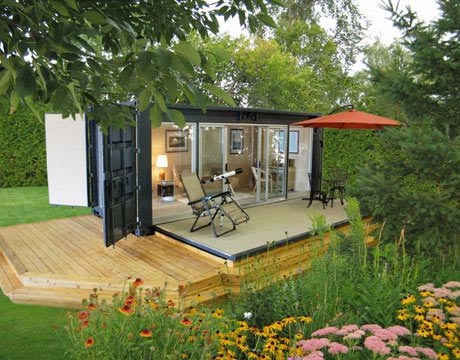
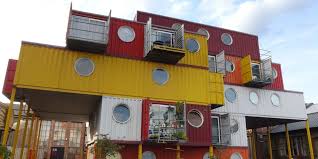
Now, what can you do with a shipping container?  Honestly, the possibilities are endless.  Dig a bit and put it underground, or build a deck around it for a swimming pool.  Leave it simple, and, if it's temporary, use it as a garage, workshop, extra storage, or whatever, after you move out.  Or make it as elaborate as you want, either as a single container, or with several put together.  Cut out sides, alter the roof line, whatever you can think of.  I'm not going to get into a lot of detail on this, just because the internet is already so saturated with loads of information out there on using shipping containers as homes.  So I'll just leave you this time with a LOT of pictures.  Let your imagination go wild!


Monday, May 16, 2016

Temporary Housing Part 3: Pre-Fab

Ok, bear with me on this one.  When I say pre-fab, I'm not talking about the run-of-the-mill fabricated housing that you can find in anytown, USA.  Those do serve a purpose, and actually can be used for the purposes discussed here, if so desired.  But I want to talk about something a little bit different.

So what am I talking about?  A simple search online for prefab structures will yield numerous results.  Because of the sheer amount of companies that create pre-fab housing and other structures, the price range is huge.  The prices generally range anywhere from roughly $1,000 to upwards of $90,000, depending on what you want.  Some will list a price in square footage.  That may give greater customization, but it can add up surprisingly fast.  You could even take an otherwise inocuous pre-made structure like a shed and turn it into a tiny house with a bit of work.  Or you can go as simple as to buy building plans for somewhere in the neighborhood of $150.00.  But aside from the typical pre-fab housing that we are all used to,  I'd like to point out a few options that aren't typical.  If you like the idea of different and unique, then these products just might be for you.


First, is a company called Intershelter.  It's really a neat idea of a series of prefabricated panels, made from an "aerospace composite material".  These panels are designed to be put together and taken apart quickly, generally, in just a few hours.  They are circular and concave in shape, thus creating a dome.  The website claims that once built, they can withstand earthquakes, category 5 hurricanes, and tempuratures ranging from -70F to +120F, making it ideal for any climate.  There are pricing differences depending on the climate you are buying for.  They offer 14 foot or 20 foot diameter.  For a 14 foot, the basic dome runs $9,500, and a "polar dome" runs $11,500.  A kit for a single dome can fit easily into the bed of a pickup to make for easy portablility, and two or more can be attached together for a bigger space.


Then there is Green Magic Homes.  I personally, really like the look of these.  Again, they are prefabricated panels.  Only this time, they are designed specifically to be placed with earth on top of them, making them, more or less, an underground home.  The shape of the panels is somewhat difficult to describe.  Once the panels are fit together, and they are covered, the pressure of the soil above and around actually pushes the panels in towards each other, making them stronger.  They arrive, ready to put up using only glue and screws.  On average, it will most likely take a couple of days for completion of the build.  The site, itself, lists no prices, asking for you to request the information from them.  However, through numerous "outside" sources, the prices seem to range from $35.00 - $42.00 per square foot, with the sizes being 700 to 1,900 square feet.  And, just like the dome, multiple units can be put together to form bigger living spaces.  It just comes down to how much you want to spend.

Now, both of the previous products are the shells only.  There is nothing else included: no bathrooms, kitchens, etc.  This is also the same as both the yurts and inflatable concrete I discussed in my last two posts.  All of that is work that you will have to take upon yourself.  My final option for pre-fab housing, however, is somewhat different.  Now, to my knowledge, none of these have officially hit the market, yet.  But they are well on their way.  Here, I am talking about homes built for the annual Solar Decathalon put on by the US Department of Energy.  Teams of college students from around the country are asked to design solar powered homes that are affordable, functional, and eco-friendly.  Designed to be premanent dwellings, I'm including them here because they tend to be pre-fab designs of some sort, which helps with the affordability.  Most claim to run in the neighborhood of $20,000.  While that may be a bit more than you'd like to pay if this is going to be temporary, if it's a permanent home, that would be a great deal.  But, if nothing else, it can give you some great ideas to let your creativity go and have some fun with design.


If the idea of pre-fab calls to you, there are many many many other sites and companies out there that offer a wide variety of products at an equally varied range in pricing.  In fact, here is one I came across shortly before this posting.  I haven't had the chance to thoroughly research it yet, but it looks promising.  And there are constantly new options coming onto the market in this area.  It always comes down to the simple question of how much you are willing to spend.